Zomato vs Swiggy vs ONDC: Which Platform Should Your Restaurant Prioritise in 2026?
The online food delivery platforms India relies on have reached unprecedented scale. The domestic food tech sector is undergoing rapid expansion, transitioning food ordering from an occasional luxury into routine daily sustenance.

For restaurant owners, cloud kitchen operators, and food entrepreneurs, this boom brings a critical operational puzzle. The days of simply listing on the two major tech aggregators are evolving. The rapid expansion of the government-backed Open Network for Digital Commerce (ONDC) has disrupted market dynamics, presenting businesses with a highly decentralized choice. Navigating Zomato vs Swiggy vs ONDC effectively is now the defining factor for restaurant profitability.
Overview of India's Leading Food Delivery Channels
Zomato
As a dominant market force, Zomato provides restaurants with immense consumer visibility and a highly mature user base. Its platform ecosystem is highly optimized for culinary discovery, offering robust marketing tools, targeted in-app native advertising, and a deeply entrenched premium customer base through its loyalty programs.
Swiggy
Swiggy matches this footprint with a highly sophisticated, hyper-local logistical infrastructure. Known for high order frequencies and fast dispatch speeds, Swiggy leverages its vast quick-commerce ecosystem to keep consumers engaged. It remains a reliable volume driver for quick-service restaurants (QSRs) and cloud kitchens nationwide.
ONDC
Unlike traditional marketplaces, ONDC functions as an open, interoperable network. Instead of trapping businesses inside a single app, it permits restaurants to display their menus across various buyer applications (like Paytm, Magicpin, and corporate apps) while using independent third-party logistics provider networks. Its core value proposition is structural: drastically reduced commission fees and direct control over transactions.
Key Differences That Matter to Your Bottom Line
When choosing the best platform for restaurants India has to offer, operators must look past top-line order volumes and evaluate four operational pillars:
Commission Structures: Zomato and Swiggy charge base commissions ranging from 18% to 30%, which often climb higher when factoring in payment gateways and mandatory discounting. ONDC operates on a nominal network fee model, keeping transaction costs under 8-12% including logistics.
Customer Reach and Demand: Zomato and Swiggy hold massive, non-stop organic consumer traffic. ONDC's demand is growing but remains reliant on buyer app visibility and active promotions to route users to the network.
Control Over Pricing and Data: Aggregators shield consumer data, preventing direct remarketing. ONDC allows restaurants to own their data, while offering the flexibility to maintain uniform menu pricing without artificially inflating rates to cover platform commissions.
Technology and Ease of Use: The established duopoly provides seamless, all-in-one merchant dashboards and dedicated account support. ONDC requires a bit more technical setup through specialized seller apps to manage catalogs and coordinate multi-provider delivery dispatching.
Weighing the Pros and Cons
Every delivery channel forces a distinct structural trade-off:
Platform Category | Core Advantages | Major Disadvantages |
Zomato & Swiggy | Immediate scale, massive organic reach, automated logistics management. | High customer acquisition costs, margin compression via heavy discount pressures, zero customer data ownership. |
ONDC | Superior profit margins per order, freedom from closed marketplace algorithms, transparent pricing. | Lower baseline organic demand, requires active brand pull to drive steady order volume. |
Ultimately, it is a direct trade-off between high-volume customer acquisition and per-order profitability.
Which Platform Should You Prioritise?
Your primary operational focus should align directly with your brand's market maturity and immediate business goals:
New Restaurants & Launching Brands
If you are newly entering the market, visibility is your biggest hurdle. Prioritise Zomato and Swiggy during your first six months. Treat their steep commissions as a marketing expense to build immediate brand awareness, test menu market-fit, and secure early customer reviews.
Growing Outlets & Expanding Cloud Kitchens
Once your kitchen achieves stable operational volume, transition to a balanced hybrid approach. Maintain your presence on major aggregators to capture baseline market demand, but simultaneously onboard your brand onto ONDC for restaurants via a trusted seller app to capture high-margin repeat business.
Mature Businesses & Established Regional Chains
Established players with high organic search volumes should aggressively focus on maximizing profit margins. Shift your primary growth focus toward ONDC and direct-to-consumer (D2C) channels to intentionally reduce your dependency on aggregators, migrating your loyal customer base over to lower-commission channels using targeted package inserts and exclusive digital perks.
The Smart Multi-Platform Food Business Strategy
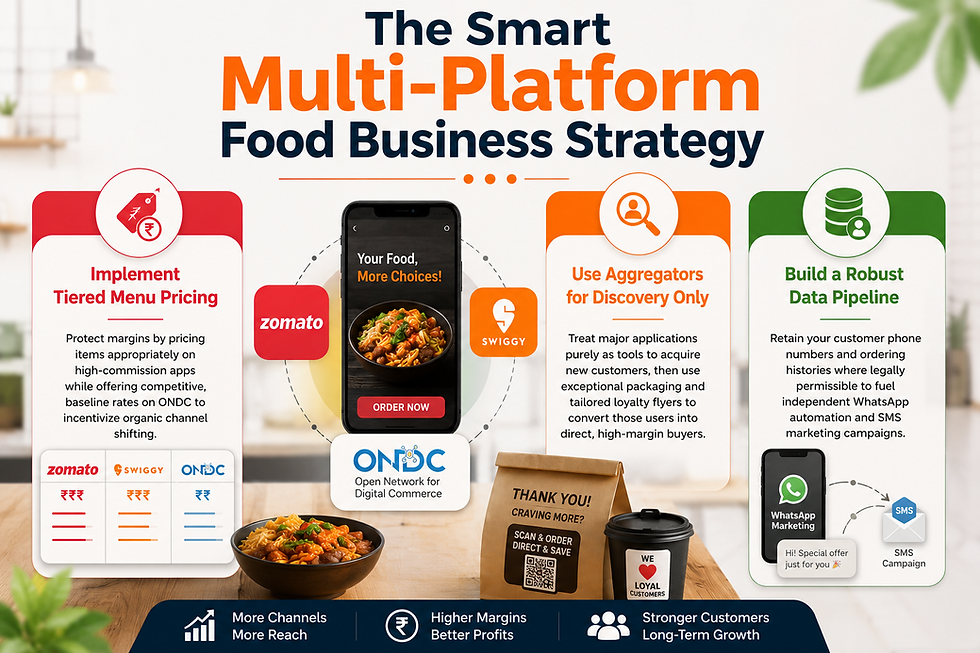
Succeeding in the current landscape requires moving away from single-platform dependency. The most profitable brands use a calculated multi-platform food business strategy:
Implement Tiered Menu Pricing: Protect margins by pricing items appropriately on high-commission apps while offering competitive, baseline rates on ONDC to incentivize organic channel shifting.
Use Aggregators for Discovery Only: Treat major applications purely as tools to acquire new customers, then use exceptional packaging and tailored loyalty flyers to convert those users into direct, high-margin buyers.
Build a Robust Data Pipeline: Retain your customer phone numbers and ordering histories where legally permissible to fuel independent WhatsApp automation and SMS marketing campaigns.
Maximizing your food delivery revenue is no longer about choosing a single winner. The modern ecosystem demands an agile, hybrid operational model that leverages big-tech reach for initial customer acquisition while using open networks to protect long-term profitability. At Spice Advisors, we specialize in helping culinary brands engineer high-margin menus, implement multi-channel POS infrastructures, and balance platform distribution networks. Contact our team today to build a tailored growth strategy that protects your margins and helps you scale efficiently.


Comments